




































KubeDB Platform API Reference
The KubeDB Platform API Server is the backend server of the KubeDB Platform. This page gives you both the whole-system picture — what the server does, how it is put together, how requests are authenticated and authorized, and how the pieces fit into typical flows — and the entry point to the low-level, endpoint-by-endpoint reference. Every endpoint on the per-group pages lists its HTTP method, path, authentication, path/query parameters, and request/response shapes so you can implement a client directly against it.
All routes are served under the /api/v1 prefix unless noted otherwise. The
marketplace webhook service is a separate listener rooted at /marketplace/api/v1.
A machine-readable OpenAPI 3.0.3 specification of this API is
also available (openapi.yaml) — load it into any OpenAPI tool (Swagger UI, Redoc,
openapi-generator) to explore the API or generate a client. A self-contained,
interactive Swagger UI viewer (with the spec inlined) is also
published for this release — open it to browse and try every endpoint in the browser.
Overview
The KubeDB Platform API Server combines an identity foundation (users, organizations, teams, authentication) with a multi-cluster Kubernetes management platform providing:
- Identity & access management — users, organizations, teams, fine-grained authorization.
- Cluster management — import, provision, and operate Kubernetes clusters (hub/spoke via Open Cluster Management, Rancher, cloud providers).
- A full Kubernetes API proxy — the KubeDB Platform UI talks to member clusters through the KubeDB Platform API Server.
- Licensing & contracts — issuing and enforcing product licenses (KubeDB, KubeStash, KubeVault, Voyager, …).
- Billing & usage reporting — usage aggregation, invoices, cloud-marketplace metering (AWS/Azure/GCP).
- Monitoring & telemetry — telemetry stack provisioning, Prometheus/Trickster auth proxying.
System Architecture

Key runtime facts:
- One binary, multiple subcommands. The default command is the API server;
marketplace,monitor,aggregator, andsummaryrun as separate processes for async/billing workloads. - NATS/JetStream is the event backbone: member clusters push resource/usage events;
monitorandaggregatorconsume them; the API server also uses NATS for its task manager and per-user credentials. - FluxCD (HelmRelease) and OCM (ManagedCluster) are used to deploy KubeDB Platform features onto clusters and to manage hub→spoke relationships.
- Deployment modes are switched by
DEPLOYMENT_TYPE: AppsCode-hosted, self-hosted (incl. offline installer), or AWS/GCP marketplace deployments. Some API groups only exist in specific modes (noted below).
Authentication & Authorization
Most endpoints require a personal access token. Send it as an HTTP header:
Authorization: token <YOUR_TOKEN>
You can also pass it as a token or access_token query parameter. Token-management
endpoints accept HTTP Basic auth. The web console uses a session cookie
(i_like_ace); a session cookie alone does not authenticate the token-guarded
REST endpoints — use a token.
The server supports several authentication mechanisms:
| Mechanism | Used by | Notes |
|---|---|---|
| Session cookie | Web console | Cookie-based sign-in; CSRF-protected |
| Personal access token / Bearer token | API clients, CLI | Authorization: token <t>, ?token=, ?access_token= |
| Basic auth | Token management endpoints | With optional OTP (2FA) |
| OAuth2 / OIDC | SSO; the KubeDB Platform API Server is both provider and consumer | /login/oauth/*, /.well-known/openid-configuration |
| LDAP / PAM | Enterprise sign-in sources | Configured by site admins |
| 2FA / WebAuthn | User accounts | TOTP, scratch tokens, security keys |
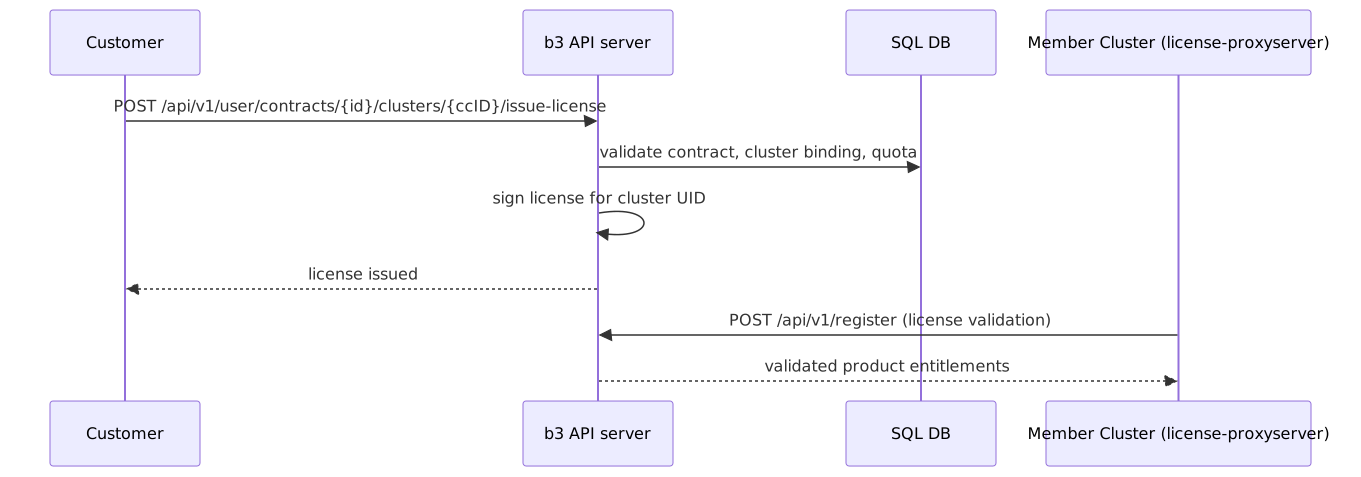
| License-based auth | Member clusters | Clusters authenticate with issued licenses / cluster tokens |
| Sudo | Site admins | Impersonate a user via sudo param/header |
Authorization is relationship-based (OpenFGA-style checks, shown as authzCheck(<permission>) in the
reference tables). Common middleware referenced in the API tables:
- Token — authenticated request required (
reqToken). - Site admin — platform administrator only.
- Org context — org resolved from path or
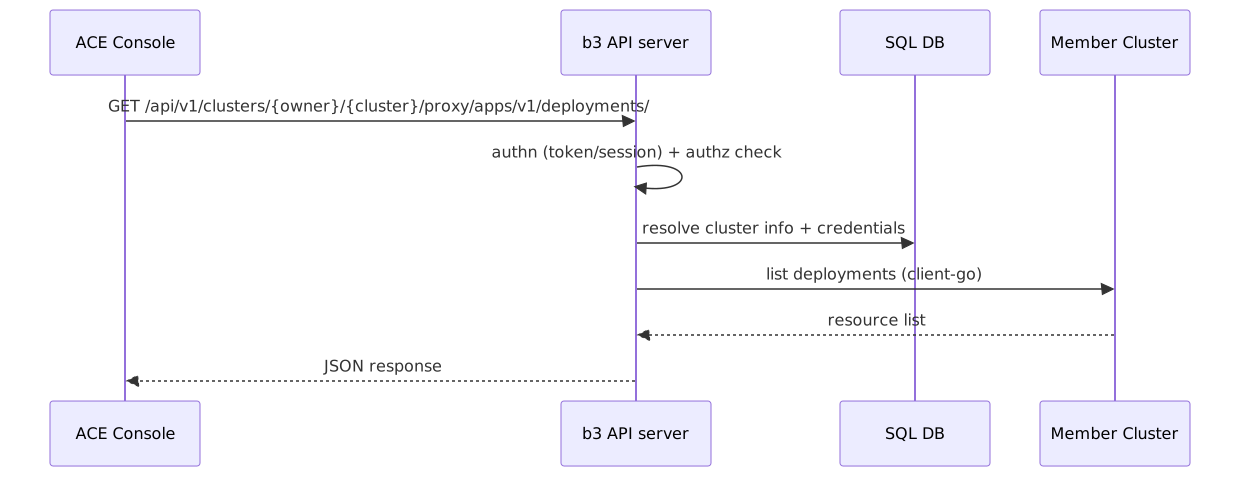
?org=query; membership/ownership verified. - Cluster assignment — resolves owner+cluster, loads cluster credentials, builds a Kubernetes client.
- Public — no authentication beyond baseline middleware.
Baseline middleware on every /api/v1 route: optional-sign-in, NATS connection cleanup,
security headers (nosniff), API context, sudo support.
API Groups
The v1 API surface is organized into the following logical groups:
| # | Group | Base path(s) | What it covers | Availability |
|---|---|---|---|---|
| 1 | Identity: Users & Settings | /api/v1/user, /api/v1/users | Accounts, profile/security settings, tokens, credentials | always |
| 2 | Identity: Organizations & Teams | /api/v1/orgs, /api/v1/teams | Orgs, members, teams, org tokens | always |
| 3 | Administration | /api/v1/admin, /api/v1/accounts/admin | Admin console, site settings | always |
| 4 | Authorization (Roles & Permissions) | /api/v1/authz | Custom roles & permissions | always |
| 5 | Cluster Management (v1 + K8s proxy + Helm) | /api/v1/clusters | Cluster lifecycle, Kubernetes proxy, Helm | always |
| 6 | Cluster Management v2 | /api/v1/clustersv2 | Hub-aware cluster API, subscriptions, gateways | always |
| 7 | Multi-cluster (OCM hub/spoke) | /api/v1/clusters/:owner/:cluster/... | Hub/spoke, cluster sets, feature sets | always |
| 8 | Client Organizations | /api/v1/user/client*, /api/v1/clusters/.../permission | Managed-service client orgs | always |
| 9 | Cloud Providers | /api/v1/clouds | Provider discovery for provisioning | always |
| 10 | Platform Installer | /api/v1/ace-installer | Self-host installer bundles | AppsCode-hosted only |
| 11 | Platform Upgrade | /api/v1/upgrade, /api/v1/clusters/.../upgrade | Platform & cluster upgrades | always |
| 12 | Licensing & Contracts | /api/v1/contracts, /api/v1/user/contracts, /api/v1/register, /api/v1/license | Contracts, licenses, registration | contracts: AppsCode-hosted |
| 13 | Billing Dashboard & Usage Reports | /api/v1/dashboard, /api/v1/user/dashboard, /api/v1/dbaas | Usage reports & billing dashboards | billing-enabled deployments |
| 14 | Marketplace | /api/v1/marketplaces (separate service), /api/v1/proxy/metered-billing | Cloud-marketplace webhooks & metering | marketplace deployments |
| 15 | Monitoring & Telemetry | /api/v1/telemetry, /api/v1/trickster | Telemetry stack, Trickster auth proxy | always |
| 16 | Rancher Integration | /api/v1/rancher | Rancher sync & proxy | always |
| 17 | Helm Chart Repositories (public) | /api/v1/chartrepositories | Public Helm chart repositories | always |
| 18 | Miscellaneous & Site Settings | /api/v1/version, /api/v1/markdown, /api/v1/branding, … | Version, markdown, health | always |

Typical Request Flows
Cluster resource access via the Kubernetes proxy
License issuance for a contract cluster
Usage → billing pipeline

Deployment Modes
| Mode | DEPLOYMENT_TYPE | Notes |
|---|---|---|
| AppsCode-hosted (SaaS) | Hosted | Full surface incl. contracts admin, installer, Firebase tokens |
| Self-hosted | SelfHostedProduction (offline installs also set the separate OfflineInstaller flag) | Runs from a generated installer bundle; /selfhost console URL |
| AWS Marketplace | AWSMarketplace | Marketplace webhooks + AWS metering proxy enabled |
| GCP Marketplace | GoogleCloudMarketplace | Marketplace webhooks + GCP metering proxy enabled |
| Azure Marketplace | AzureMarketplace | Recognized marketplace mode (webhooks); no metering proxy wired up |
Feature gating summary:
AppsCodeHosted→ contracts admin APIs, installer APIs, org claim, Firebase token.IsBillingEnabled()→ billing dashboard APIs (admin, user, usage reports).DeploymentType→ which marketplace metering proxy (if any) is registered.- License enforcement is compiled in (
ENFORCE_LICENSE=true); the server validates its own license at startup.